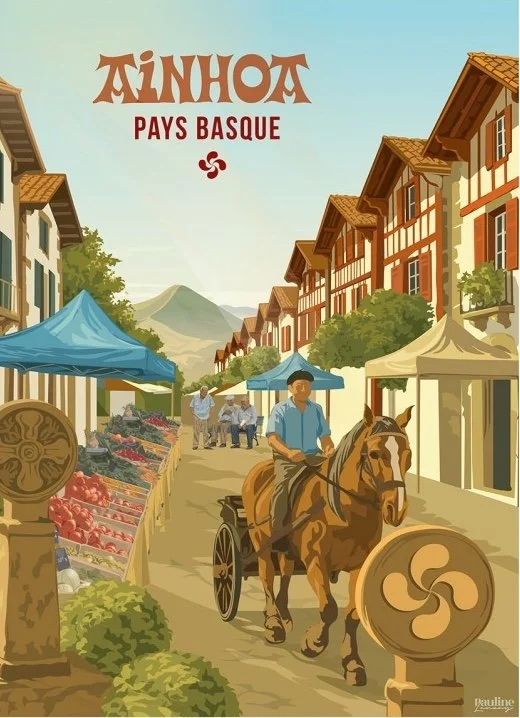
Côte Basque Weekend
Fri 11 → Sun 13 Sept 2026 Fred + Ainhoa · v2

Côte Basquetwo days, a spring tide, and a village that shares her name

One anchor per day, and they point in opposite directions. Saturday goes inland — Espelette, then Ainhoa, then a starred lunch on the fronton square and the climb to the chapel above it. Sunday goes down the coast and ends in Bayonne, in a museum that reopened last November after fourteen years shut. Everything else is a beach, a market, or dinner.

Base  Biarritz, Halles quarter — not booked yet Out  TGV 8553 · Montparnasse 20:03 Car  Hertz at BIQ, Sat 09:00 Home  TO7009 · BIQ 20:00 Sunday

Tonight, from the sofa

Six things, in deadline order. The first one is the binding constraint on the whole weekend and it is not the transport.

1  Book the hotel — before anything else
Le Temps d'Aimer la Danse runs 10–21 September, which puts your weekend inside the biggest cultural fortnight of the Biarritz year — the 36th edition, and publicly billed as Thierry Malandain's last as director before Martin Harriague takes over. That is a festival with a valedictory crowd attached to it. Rooms and rates on the Côte Basque will both be worse than an ordinary September weekend. Options below the Friday leg. Ask about a bag-drop on the Sunday while you are at it — though the plan is that you do not need one.
2  Book TGV 8553, Montparnasse 20:03
This train only runs on Fridays — a relief service operating Fridays from 4 September to 20 November, Montparnasse 20:03, Biarritz 00:20. It is the only departure after 19:00 that gets you there the same night. The next one down, 8551, leaves at 18:44 on Fridays (not the 18:38 the aggregators show) and arrives 22:51 — better arrival, wrong departure. See the explainer for why this is a Friday-only timetable and why the night train is not the answer you would expect.
3  Book the way home — Transavia TO7009, Sunday 20:00
BIQ 20:00, Orly around 21:30. It is the last thing out of Biarritz on the Sunday and it costs you almost nothing, because the airport is 3.5 km from where the weekend starts. No dawn alarm, no Monday to write off, and you are in the Marais before midnight. Arrival time is computed from the published departure and the airport's stated 1h25–1h40 block, not from a published arrivals table — treat 21:30 as ±15 minutes.
4  Book Ithurria for Saturday lunch
One Michelin star, on the fronton square at Ainhoa, in a village of 672 people, on a September Saturday. Four generations of the Isabal family since 1962. Order the tasting menu by 13:00 — that is their stated cut-off, not the service end. €92 for five courses, €135 for six. 05 59 29 92 11.
5  Book the car with Hertz at the airport — not Sixt
You need a car for both days; Ainhoa has no useful public transport and the Sunday ends at the airport. Hertz at Biarritz airport runs Sat–Sun 09:00–22:30. Sixt shuts at 19:00 on a Sunday, which is fifteen minutes after you want to hand the keys back. Book Hertz, Saturday 09:00 to Sunday 18:45, collect and return at the same desk — the car starts and ends where the trip ends, and nothing needs repositioning.
6  Pre-book the 00:20 transfer from the station
Biarritz's station is not in Biarritz. It is Biarritz-La Négresse, 3 km inland — the empress is said to have wanted the railway kept away from her villa. The airport bus does not run on Sundays or after 21:29 any day, town buses have long stopped by midnight, and the rank at La Négresse at half past midnight is a matter of luck. Twenty-odd euros arranged with the hotel, or a bad twenty minutes.

Conditions, which make the choices

You have booked a grande marée, and it is on your side

Tidal coefficients on this coast run 20 to 120. Yours are 102 and 101 on Saturday, 100 and 97 on Sunday — exceptional, and the range is about 3.6 m in six hours. That has two consequences, one bad and one very good.

The bad one: the Côte des Basques stops existing at high water. At 4.38 m on Saturday evening the sea is against the wall. Do not be on the sand under that cliff between roughly 16:30 and 20:00 Saturday, or 17:00 and 20:30 Sunday.

The good one: low water lands in the middle of the day on both days. From about 10:30 to 14:30 you get the widest, flattest version of that beach anywhere on the calendar, with the foreshore out further than on any ordinary day. This is why Sunday's swim is at half past twelve and not at four o'clock, and it is the single fact the whole Sunday is built around.

 LowHighLowHighCoeff.
Sat 1200:1105:5812:2218:15 · 4.38 m102 / 101
Sun 1300:4606:3412:5718:51 · 4.28 m100 / 97

Honest provenance: the coefficients come from maree.info's published September 2026 calendar for Boucau-Bayonne and are solid. The times are from TideTime, not from SHOM — SHOM's own service is behind a JavaScript gate and every free predictor only reaches ten days ahead. Cross-checked against two other predictors for a date I could see: high water agrees within ~5 minutes, low water diverges by up to 20. Treat these as ±10 and ±20 and read the board on the beach before trusting them with anything that matters.

Weather posture: the jumper is not optional

Biarritz is one of the wettest towns in France — roughly 1,470 mm a year and 118 mm in September across about ten rain days. That arithmetic is the point: twelve millimetres per wet day. It does not drizzle here. It arrives, empties, and leaves, and the sky is blue again by lunch. Normals for September: max 23.3°C, min 14.5°C, 6.5 hours of sun a day. Sea temperature 20–22°C — the warmest the Atlantic gets here, and late-August readings this year are running nearly three degrees above average.

The specific local hazard has a name: the galerne (Basque enbata, locally brouillarta). A cold north-westerly squall out of the Bay of Biscay, funnelled along the Cantabrian coast, most common in spring and autumn — which is you. The signature is a fast pressure drop and a temperature fall of up to 12°C in twenty minutes; Biarritz recorded 15.5°C in half an hour in June 2022. Winds to 100 km/h and short violent rain. A hot still afternoon on the Côte des Basques can become horizontal water before you have finished a drink.

Rain improves three things here: the Musée Bonnat-Helleu at Bayonne, the Musée de la Mer on the Rocher de la Vierge headland, and every galleried church interior on the itinerary — Ainhoa, Espelette, Saint-Jean-de-Luz — which are dark, timbered and better without glare. Rain ruins exactly one thing: the climb to the Chapelle de l'Aubépine. Sunset both days is about 20:23, with usable light to 20:50. A jacket, not an umbrella; the wind takes umbrellas.

11 Friday Four hours down the Atlantic edge

Do not plan a dinner. Buy one at Montparnasse and eat it before Bordeaux. There is exactly one kitchen open when you land and it is a tapas bar.

19:20métro · ~20 min
Le Marais → Paris Montparnasse
Line 4 from Châtelet, or line 12 · Hall 1, main departure board

This is the whole argument for the train on the way out. Montparnasse is twenty minutes away and you are on a platform; Roissy is an hour away and you are in a queue. The 20:15 Air France to Biarritz exists and lands at 21:45, but it needs you out of the Marais by 18:15, which is not the evening you have.

Buy dinner before the barrier. There is a bar on board and it is a bar. You will pass Bordeaux at 22:12 and Dax at 23:34, and the only thing open at the far end is a tapas counter.
20:03TGV 8553 · Fridays only
Montparnasse → Biarritz (terminus Hendaye)
Massy 20:12 · Bordeaux 22:12 · Dax 23:34 · Bayonne 00:08 · Biarritz 00:20

Four hours seventeen, door to door about five and a half from the Marais — which is honest, and roughly what the flight costs you once you have added Roissy at each end. The line runs Paris–Bordeaux–Dax–Bayonne–Biarritz–Saint-Jean-de-Luz–Hendaye, so Biarritz is an intermediate stop and you have twelve minutes' warning from Bayonne. Fares seen on this service around €95.

The 18:44 is the trap, not the fallback. Aggregators show a "last train 18:38" because 8551's base pattern excludes Fridays — there is a separate Friday variant at 18:44 arriving 22:51, and it was quoted higher than the later train. Timings verified against SNCF running-day data via a third-party mirror of the open data, not on SNCF Connect itself — it caught the Friday variants that every commercial site got wrong, but re-check when you book.
00:20pre-booked · ~€20–25
Biarritz-La Négresse → the centre
3 km · 8–10 min · no bus at this hour, any day

The station sits in the La Négresse quarter, inland and uphill from everything. In daylight the T1 tram-bus does it in about fifteen minutes for a euro. At 00:20 it does not exist. Arrange the car when you book the hotel — they do this every Friday of the year.

Bus line numbers for this station are genuinely unsettled. The tourist office says lines 5 and 12; Wikipedia lists six different numbers; the whole network was rebranded from Chronoplus to Txik Txak and renumbered, so every secondary source is suspect. Irrelevant tonight, relevant if you ever try to reach the station on foot-plus-bus. Check txiktxak.fr on the day, not before.
Show the driver · destination
Hôtel de Silhouette, 30 rue Gambetta, 64200 Biarritz
00:45if you still want food
Bar Jean — the only thing open
5 rue des Halles · 7/7, service continu 10:30–02:00 · no bookings

Seville-tiled, family-run since the 1930s, on the flank of Les Halles, and it does not close. Chipirons à l'encre — local squid in their own ink with rice — merlu koskera, axoa de veau, and a tapas counter of ham croquettes, fried anchovies, razor clams and cèpes. You walk in; there are no reservations except for parties of ten.

02:00 is the bar's closing time, not a published last-order for the kitchen — that figure comes from their own site in two places but nobody states when the plancha stops. Worst case is a plate of ham and a glass of Irouléguy, which is an acceptable stake. I could not verify any other Biarritz kitchen serving at midnight; La Belloteka on rue du Centre runs to 23:30 seven nights and is the earlier-arrival answer.
Paste-string
Bar Jean, 5 rue des Halles, 64200 Biarritz

The base — five rooms, one recommendation

Hôtel de Silhouette, 30 rue Gambetta. A 17th-century building fully renovated, interiors by the Madrid firm Hurlé & Martin in tobacco, terracotta and deep red, a rear garden, and 27 keys including six suites in the adjoining Maison Silhouette opened in June 2025. The operational reason it wins: it is in the Halles quarter. You land at half past midnight and dinner is sixty seconds away; you wake on Saturday and the producers' market is sixty seconds away. On a weekend whose two anchors are both out of town, the right hotel is the one you do not have to think about. hotel-silhouette-biarritz.com

Régina Experimental, 52 avenue de l'Impératrice — the best building on the list and Ainhoa's kind of room. A Belle Époque landmark by the lighthouse, restored by Dorothée Meilichzon, with a monumental 15-metre atrium under a glass roof and 72 rooms facing the sea. Heated outdoor pool, late April to October. Frenchie Biarritz, Grégory Marchand's brasserie, is downstairs and opens seven days a week. The catch is a kilometre of avenue de l'Impératrice between you and Les Halles — twelve to fifteen minutes, uphill on the way back, unpleasant in a galerne. experimentalgroup.com

Hôtel du Palais, 1 avenue de l'Impératrice — and here is the thing nobody's guidebook says. Built in 1854 as the Villa Eugénie for Napoleon III, burned in 1903, rebuilt by Édouard Niermans in reinforced concrete behind the surviving walls, listed in 1993, €80m renovation reopened in 2021. In March 2026 it lost its "Palace" distinction. Atout France's commission delisted it — management told staff on 26 March, the decision was reported in May, and the stated reason is that the spa, the breakfast room and the north-wing bathrooms were never part of the 2021 works. It is still a five-star with the best position on the Grande Plage, a heated seawater pool with direct beach access, and a starred restaurant. But the delisting is an official statement that specific parts of it are not worth palace money. If you book it, book a renovated ocean-facing room and ask the hotel directly which floors were in the works. hyatt.com · +33 5 59 41 12 34

Villa Koegui, 7 rue de Gascogne — the value play. Fifteen rooms and a suite around a courtyard with a fountain, renovated 2021, two minutes from the Grande Plage and two minutes from Les Halles, which is the best walkability on this page. No pool, no spa, no restaurant — a courtyard with a fountain in it instead. hotel-villakoegui-biarritz.fr

Beaumanoir, 10 avenue de Tamames — eight keys in a manor in the Quartier du Parc d'Hiver, heated pool, and the only one on this list with free private parking, which matters because you have a car for both days. Against it: the Parc d'Hiver is inland, and "walking distance to the beaches" means fifteen to twenty minutes. The parking claim comes from an aggregator, not the hotel — their own site's certificate is broken and would not load. Confirm it before you count on it.

No nightly rates here on purpose. I have no live quotes for these dates and, with Le Temps d'Aimer running, teaser prices from aggregators would be actively misleading. Book direct and make them confirm.

12 Saturday Espelette, Ainhoa, and a hill

Peppers on the walls at Espelette, then the village, then a starred lunch on the fronton square, then a climb. Back in Biarritz by six, and dinner is two minutes from the sunset.

08:15Saturday only
Les Halles de Biarritz — the producers' market
Rue des Halles / place Sobradiel · covered hall daily 07:30–14:00 · producers outside Sat 07:30–13:00

The covered market runs every day; the outdoor producers' market is Saturdays, and this is your only one. Cheese, fish, charcuterie, pastry, wine. Buy nothing heavy — you are about to spend eight hours in a hire car — but this is where the Ossau-Iraty and the gâteau basque come from, and it is forty minutes well spent. Coffee afterwards at Miremont, place Clemenceau, the 1872 salon de thé: order the chocolat chaud chantilly, which the house names as its own speciality.

Ask which filling. A gâteau basque is either crème pâtissière or black-cherry jam, and if it is cherry the only answer worth having is cerise noire d'Itxassou. The industrial trade makes a thousand tonnes a year at Bonloc. Miremont's hours — daily 09:00–20:00 — are from their own contact page, which carries a 2018 copyright. The business is plainly alive; ring before a 09:00 arrival.
Paste-string
Les Halles de Biarritz, rue des Halles, 64200 Biarritz
09:00Hertz opens 09:00
Collect the car — Biarritz Pays Basque airport
Esplanade de l'Europe, on the terminal forecourt · 3.5 km, ~10 min by taxi

Hertz opens at 09:00 on Saturdays and Sundays and runs to 22:30 both days — the only desk in the region that covers both ends of this trip. Take a taxi out; you are bringing the car back to the same place before the flight, so nothing needs repositioning and there is no one-way drop fee.

Do not book Sixt for this. Their Sunday desk shuts at 19:00 and your flight is at 20:00. Avis at the station is the alternative — 07:00–23:00 daily, 24/7 returns — but their own listing gives a Biarritz station address while directing you to Place des Basques, which is in Bayonne. Confirm which station that desk actually serves before you rely on it.
Sat-nav destination
Aéroport de Biarritz Pays Basque, Esplanade de l'Europe
09:45drive · 25 km, ~29 min
Espelette — Ezpeleta
Free parking at the fronton and the village entrances · arrive before 10:00 · ~90 min here

You have arrived in the one fortnight of the year this village is worth the detour. The peppers go up on the sun-facing walls immediately after picking, from August until the first frosts, and late summer is when you see the most of them. The Fête du Piment is the last weekend of October and draws ten thousand people; 12 September gives you the façades without the crush.

Three things, ninety minutes. L'Atelier du Piment, Elizaldeko Bidea — the guided tour is free, about an hour, takes you through fields, greenhouses and drying rooms, ends in a tasting, and needs no reservation. Église Saint-Étienne, begun 1593: a fortress silhouette, three tiers of wooden galleries, a restored 17th-century gilded retable with twisted columns, and a churchyard of discoidal steles. The Château des barons d'Ezpeleta was given to the villagers in 1694 and now holds the mairie, the tourist office and the municipal library — you walk into a monument historique because it is the town hall.

No market. Espelette's market is Wednesday, year-round; the Saturday producers' market runs in July and August only. The Atelier du Piment's hours (daily 10:00–13:00 and 14:00–18:00) and the free tour rest on a single intermediary source — their own site and the departmental tourist board both blocked automated access. One call settles it: 05 59 93 90 21.
Paste-string
L'Atelier du Piment, Elizaldeko Bidea, 64250 Espelette
11:45drive · 12 km, 18 min
Ainhoa — 64250, population 672
Karrika Nagusia · blue zone at the fronton, 2 hrs max, 09:00–19:00

A bastide-rue: one wide street, houses aligned on both sides, founded by Premonstratensian monks in the 13th century as a staging post on the road to Compostela. Les Plus Beaux Villages de France, confirmed. Spain is two kilometres south at Dantxarinea. You have an hour here before lunch, and it is enough, because the village is one street.

What you are actually looking at: Ainhoa was razed in the Spanish invasion of 1636 and rebuilt after the Treaty of the Pyrenees in 1659, which is why almost the entire street reads as a single 17th-century campaign. Look for the dated lintels in pink sandstone above the doors. The one to find is Gorritia, 1662, whose inscription records that Marie de Gorriti bought the house back with money her family sent home from America — the whole Basque emigration economy in one carved sentence. The oldest house, Matxitorenea, predates the burning. There is an 1858 lavoir that Napoleon III and Eugénie came to see.

Then the square, which has three things on it and they are the same thing three times over. Église Notre-Dame-de-l'Assomption — built on a 12th-century fortified house, listed in 1996, single nave, no pillars, timber ceiling, tiers of wooden galleries and a gilded retable. The churchyard, full of discoidal hilarri with almost no dates on them, one of which belongs to M. H. L. Fabre, who compiled a French–Basque dictionary in 1870. The fronton of 1849, abutting the church and the cemetery. See the explainer.

The fronton parking is a two-hour blue zone. Because you are walking up to the chapel afterwards, use the larger car park reached by turning left off the main street instead — which comes from walkers' accounts, not the mairie, along with the question of whether a disc is required. Mairie: 05 59 29 92 60. Note too that the given name is widely said to come from this village and its Virgin. I could not source that properly, so treat it as a nice story rather than a fact, and enjoy it anyway.
Paste-string · the square
Fronton d'Ainhoa, Karrika Nagusia, 64250 Ainhoa
12:45lunch · book one
Ithurria or Argi Eder
218 Karrika Nagusia · / · 64 Argiedereko bidea, quartier Boxate

Ithurria — one star, on the fronton square, opened 1962, four generations of Isabals. Aged anchovies "millésime 2024"; courgette flower with crustacean cream and caviar; a ragout of langoustine tails; half-wild Khaki duck; the chocolate dessert called d'Aita. €92 for five courses, €135 for six, pairings €25–75; à la carte mains €44–98. Lunch runs to 13:30 but tasting-menu orders close at 13:00, which is why this leg starts at 12:45 and not 13:15.

Argi Eder, five minutes out of the village — menus at €49, €65 and €85, open Thursday to Sunday for both services, and it has a park of old oaks and a pool. Bib Gourmand per one guide, unconfirmed at source. This is the sane option given that you are climbing a hill afterwards, and the honest one: five courses at 12:45 and 330 metres of ascent at three o'clock is a plan made by somebody who was not going to do it.

Confirm Ithurria's closing days by phone. Their own site says closed Tuesday lunch, all Wednesday and Thursday lunch, with menus at €92/€135; a regional guide says closed Wednesdays only, with menus at €85/€125. Both agree it is open Saturday. The star is stated as current by the restaurant, TheFork and Teritoria — Michelin's own pages would not render for me on any attempt, so no Michelin claim in this document is verified at source. There is also Ithurria Côté Bistrot, same house, lunch only, from €25, closed Wednesday and Thursday.
Paste-string
Ithurria, 218 Karrika Nagusia, 64250 Ainhoa
15:00weather decides · back at the car 17:00
Chapelle Notre-Dame-de-l'Aubépine — Arantzazuko Ama
389 m, Mont Atsulai · on foot from the village · free

A stone path lined with crosses climbs 330 metres out of the village to a chapel dedicated to the Virgin who appeared in a hawthorn. The devotional layers arrived one at a time — a Way of the Cross from 1886, a grotto from 1897, a Calvary of three crosses from 1898 — and reproductions of discoidal steles line the route. At the top, 360 degrees over Ainhoa, La Rhune, the bay of Saint-Jean-de-Luz and the ocean; the mairie calls it one of the finest panoramas in Labourd. Pottok ponies and red-headed manech sheep on the way up; griffon vultures reported.

Fifty minutes up, twenty at the top, thirty-five down. That puts you back at the car at 17:00 and in Biarritz by six.

The sources disagree about how long the climb takes. The tourist board says thirty minutes, the valley office says forty-five to sixty, a hiking site says an hour. Take fifty and you will not be far wrong. One source states vehicles have been banned from the track since 2021 to protect the site — single, uncorroborated, so assume you walk. If it is raining, do not do this: substitute Villa Arnaga at Cambo-les-Bains, 13 minutes from Espelette, open Saturday 10:00–18:00, €10 — Edmond Rostand's neo-Basque villa, which is the deliberate, monumentalised, Paris-playwright reinterpretation of everything you looked at that morning. Better argument in the rain, worse one in the sun, and it gets you back to the hotel earlier either way.
Paste-string · wet-weather substitute
Villa Arnaga, route du Docteur Camino, 64250 Cambo-les-Bains
18:00out again 19:40
The hotel
Park once — Halles Clemenceau, Sainte-Eugénie or Grande Plage, all Indigo, all 24/7

Leave the car where you put it; you will not need it again until Sunday morning. The Côte des Basques is against the wall from 16:30, so there is nothing on the front worth walking down for — the sea comes back tomorrow, in a bay with lifeguards in it.

If the chapel over-ran, this is where the time comes from. Arrive at seven, skip the headland, walk straight to dinner — the Rocher is two minutes from Chez Albert either way, and sunset is 20:24.
19:45sunset 20:24
Rocher de la Vierge — and the bridge that is not Eiffel's
Esplanade du Rocher de la Vierge · free · ten minutes on foot from the Halles

Walk down and out onto the headland. The iron footbridge to the rock is the most photographed object in Biarritz and it was not built by Eiffel — it was designed and built in 1886–87 by the ateliers Schryver & Cie, replacing a wooden bridge of 1863. The French record says the Eiffel attribution is simply wrong. Every guidebook and the tourist office still repeat it. Sunset is at 20:24 with usable light to about 20:50, and this is where to be for it.

Medium-high confidence that it is not Eiffel, medium confidence that it is Schryver — the correction rests on a single French-language source and I found no second confirmation either way. Say it with a raised eyebrow, not a lecture.
Paste-string
Rocher de la Vierge, esplanade du Rocher de la Vierge, 64200 Biarritz
20:45dinner · two minutes away
Chez Albert — Port des Pêcheurs
51 bis allée du Port des Pêcheurs · à la carte €13–89 · below the headland you are standing on

You have already eaten properly in Ainhoa, so this is deliberately not another gastronomic room, and it is two minutes from the sunset. Chez Albert sits in the little harbour of crampottes below the Atalaye plateau: Saint-Pierre rôti au four is the house signature, the shellfish platters run to lobster and velvet crab, and the oysters are Isigny pleine mer n°3 or Gillardeau n°2 with rye bread and Normandy butter. Ices by Thierry Bamas, MOF and 2011 world ice-cream champion.

If you would rather have the serious dinner tonight and a bistrot lunch in Ainhoa, swap them. The starred rooms open on a Saturday: La Table d'Aurélien Largeau, 4 rue Jean Bart, 35 covers, menus €105 and €135, dinner 19:30–21:30, closed Sunday and Monday so Saturday is its only night for you; Kaïku at Saint-Jean-de-Luz in the oldest house in the town, dated 1540, menus €60/€98/€130, also closed Sunday and Monday; and L'Impertinent, 5 rue d'Alsace, whose own website contradicts itself about which days it opens. Note that Kaïku means driving twenty-five minutes each way after a day in the car.
Paste-string
Chez Albert, 51 bis allée du Port des Pêcheurs, 64200 Biarritz
13 Sunday A slow start, a swim, and a museum on the way to the plane

The day runs in one line south to north — Saint-Jean-de-Luz, Guéthary, Bayonne, the airport — and you never double back, because the bags are in the car from the moment you check out.

09:00check out 10:30
Breakfast, then the road south
Bags into the car · out of the car park by 10:45 · 16 km, ~30 min

The one piece of admin on the whole day: you are not coming back to Biarritz. It ends at the airport, eight kilometres past the hotel in the other direction, so check out properly and load the boot — no left luggage to arrange, nothing to collect on the way through.

Out of the car park by 10:45. Saint-Jean-de-Luz has lifeguards from 12:30 and low water at 12:57, and those two facts are what the rest of the day hangs on. Everything after them has slack in it; this bit does not.
11:15Sun 08:00–19:30 · free
Église Saint-Jean-Baptiste — Saint-Jean-de-Luz
Rue Gambetta · 16 km, ~30 min from Biarritz · parish +33 5 59 26 08 81

The most impressive interior on this coast, and it is free. Louis XIV married the Infanta Maria Theresa here on 9 June 1660, and the door they left by, on the rue Gambetta side, was sealed up afterwards and is still sealed. Inside: seven tiers of carved wooden galleries, three along the sides and four at the back, renovated under Napoleon III in 1857 — men above, women in the nave below, in the Basque way. The baroque retable from the Martin de Bidache workshop is called the most spectacular in the northern Basque Country: some twenty gilded saints around Christ. Near the entrance hangs an 1865 model of a paddle steamer, an ex-voto from the Soudre family, for sailors coming home from Newfoundland.

Forty minutes inside, then place Louis XIV and the rue Gambetta on foot. Buy the macarons here, not in Biarritz — Maison Adam, 49 rue Gambetta, the soft crackle-topped almond disc, nothing to do with the Parisian sandwich. The house says it has been making them since the 1660 wedding, which is a founding legend rather than a documented record, but it is chronologically sound and thirteen generations old. Their loose chocolates are sold at only two addresses and this is one of them.

Maison Louis XIV, on the same square, is cut — and it is the one real casualty of the slower day. Built in 1643 for the shipowner Joannis de Lohobiague, still owned by the same family, the king lodged there for a month before the wedding. In September it is guided visits only, forty minutes, at 11:30, 15:00, 16:00 and 17:00. The 11:30 arrives before you do; the 15:00 lands in the middle of lunch. Take it only if you skip Guéthary and eat late.
Paste-string
Église Saint-Jean-Baptiste, rue Gambetta, 64500 Saint-Jean-de-Luz
12:35lifeguards 12:30–18:30
Grande Plage, Saint-Jean-de-Luz — the swim
Promenade Jacques Thibaud · low water 12:57 · sea ~20–22°C · an hour and a quarter

This is the swimming answer for the whole weekend and it is a piece of luck. Napoleon III ordered three dykes built to close this bay — Socoa, Sainte-Barbe, and the detached offshore Artha — after storms had destroyed over two hundred buildings in the Quartier de la Barre, including a convent and a hospital. The result is the only stretch of this coast with no Atlantic shorebreak and no baïnes.

And the surveillance calendar happens to land on you. Saint-Jean-de-Luz stops daily lifeguarding on 6 September, then covers weekends only — 12–13 and 19–20 September, 12:30 to 18:30. Your Sunday is inside it by three days' margin either side. The northern beaches here got nothing after 23 August, and Hendaye is not supervised until the 19th.

The hazard on this coast is the baïne, a rip formed between sandbars, and it is what the flags exist for. Swim inside them. Check water quality on the Kalilo app or baignades.sante.gouv.fr — a violet flag means closed on quality grounds, not on sea state. If the swell or a galerne shuts the bay, the fallback is Port-Vieux in Biarritz, a cove sheltered by a natural inlet, supervised daily 12:00–19:00 through September — but that is a detour backwards, so decide before you leave the hotel, not after.
Paste-string
Grande Plage de Saint-Jean-de-Luz, promenade Jacques Thibaud, 64500
14:15Guéthary · clifftop, then lunch
Hétéroclito or Brikéténia
Chemin de la Plage · / · 142 rue de l'Église — both Guéthary, 10 min back up the coast

Ten minutes north, the smallest village on the Basque coast: an old whaling and squid port, a handful of coloured boats behind a dyke, a Sunday market that runs April to September. Stand on the clifftop for five minutes and look at Parlementia — and be clear what you are looking at. It is an expert-only reef break running one and a half to six metres, one of France's premier big-wave spots, a twenty-minute paddle offshore; Avalanche, further out, runs three to seven. If a swell is in, this is one of the great free spectacles on the coast, watched from dry land.

Then lunch, and Sunday closes most of the good kitchens here — Kaïku, Chez Mattin, Largeau, Le Crabe Tambour, and La Grange and Le Bayonnais in Bayonne are all shut. Two things are reliably open and both are in this village. Hétéroclito, on the ocean, seven days a week March to November, kitchen open continuously 12:30–21:30 — plancha, a blackboard of whatever landed, oyster and shellfish platters, no decisions required. Brikéténia — one star, David Ibarboure, third generation, closed Monday and Tuesday, so open on your Sunday, menus €134 and €92. If Saturday's dinner was Chez Albert, this is where the weekend's serious meal goes.

Ninety minutes, and Brikéténia will not be ninety minutes. A starred lunch here and the Bonnat-Helleu are not both possible; pick one and mean it. Their own site says €134 for the grand menu, the departmental tourist board says €125 — take the house figure. The €52 "retour du marché" is lunch only and explicitly excludes Sundays. Also worth knowing: the Musée de Guéthary at the Villa Saraleguinea — Swiecinski's sculptures, Roman finds, the manuscripts of the poet Paul-Jean Toulet, €2 — is closed on Sundays, which is a genuine shame and nothing can be done about it.
Paste-string
Hétéroclito, chemin de la Plage, 64210 Guéthary
16:20Sun 10:00–19:00
Musée Bonnat-Helleu, Bayonne
5 rue Jacques-Laffitte · €11 / €8 · closed Tuesdays · +33 5 59 46 63 60

The reason the day ends inland. It closed in April 2011 and reopened on 27 November 2025 — fourteen years — with the exhibition space doubled to 3,000 m², the natural lighting restored, and the graphic arts galleries accessible for the first time. 2026 is its first full season and almost nothing in print has caught up.

Rubens, Van Dyck, El Greco, Goya, Ingres, Delacroix, Degas, Courbet. And then the actual point: over 3,500 old master drawings, reputedly the finest such holding in France outside the Louvre, with Leonardo, Raphael and Rembrandt in it. Degas's portrait of Bonnat; Ingres's newly restored Baigneuse; 181 Helleus; a run of 150 Gramont family portraits spanning 1472 to 1789. The temporary show while you are there is Mythologies, 8 July – 9 November 2026.

Park at Paulmy, Champ de Foire or Porte d'Espagne. You have an hour and three quarters, which is enough for the drawings and not enough for the whole building — go up to the graphic arts first and work backwards. If you arrive early, the cloister of the Cathédrale Sainte-Marie is free, ten minutes away, open to 18:00 in season, one of the largest in France and part of the UNESCO Compostela inscription.

Do not plan a chocolate stop. Cazenave on rue Port-Neuf — the chocolat mousseux with chantilly and toast, €10.30, hand-whipped, in rose-painted porcelain, in a salon converted from the old workshop — is closed Sunday and Monday. It needed Saturday, and Saturday was inland. The Musée Basque on the quai des Corsaires is open Sunday 10:00–18:00 if you would rather have the steles and the fronton explained properly than look at drawings; you cannot do both in an hour and three quarters.
Paste-string
Musée Bonnat-Helleu, 5 rue Jacques-Laffitte, 64100 Bayonne
18:10TO7009 · 20:00
Bayonne → BIQ → Orly
~20 min drive · Hertz open to 22:30 · bag drop closes ~19:20 · Orly ~21:30

Leave Bayonne at 18:10, drop the car at 18:35, and you have forty-five minutes of slack before bag drop. This is the whole argument for the Sunday flight: the airport is 3.5 km from the beach you started the weekend next to, the last plane is at 20:00, and you are in the Marais before midnight with a Monday that works.

If the flight dies, everything else has already gone. The last train out of Biarritz on a Sunday is OUIGO 7682 at 18:30 into Montparnasse at 23:04, and the earlier Air France was 18:20 — both long gone by the time you would know. The real fallbacks are the Intercités de Nuit from Bayonne at 20:59, Austerlitz 07:03, which is fifteen minutes back up the road you have just driven; or TGV 8530 from Biarritz at 07:25 on the Monday, Paris 11:55. Keep the Bayonne option in mind precisely because you will be standing near that station at six o'clock.

Four things worth knowing

The etxe is not a house. It is the unit of the society.

Etxea means house, but the word did the work that "family", "estate" and "surname" do elsewhere. People were named for their house, not the other way round — which you can still read in the cemeteries, where a monument is headed Etxebarneko familia, "the family of the house Etxebarne", with the individuals listed underneath. Inheritance followed the house and not the bloodline's gender: the eldest child of either sex inherited as the etxekoa, "the one destined for the house", ran the estate and supported everyone else. Which is why the dated lintel over a door in Ainhoa is a deed, not decoration. Gorritia's, of 1662, records that Marie de Gorriti bought the house back with money sent from America.

The buildings record a technological break. Before the 16th century Basque houses were entirely timber-framed and built by master carpenters; from the 16th century stone with lime-washed façades took over and masons became the principal builders. The Labourdine type — white walls, asymmetric tiled roof, exposed colombage upstairs, and the lorio, the sheltered working space made by oversailing the upper floor — is the mature form of that transition. And Ainhoa's houses are not symmetrical: the east face carries the colour, the timber and the big openings; the west face is blind and narrow. That is not taste. That is the Atlantic.

On the red and the green. The red — gorri — began as ox blood used as paint, which protected timber from insects and rot; the shade is rouge de Baigorry, from ibai gorri, "red river". Green is later, a 19th-century alternative linked to iron oxide from local soils. Blue is coastal, made from leftover boat paint by fishing families, which is why you see more of it near the sea. Two corrections: the uniformity you are admiring is partly modern planning enforcement keyed to RAL numbers, and the story that red meant owner and green meant tenant is an urban legend — a specialist asked directly calls it exactly that. Do not repeat it at lunch.

The two objects in the square: the stele and the wall

The discoidal stelehilarri, from hil, dead, and harri, stone — is the etxe's afterlife, and it is the marker running down the side of this document. A square or trapezoidal base surmounted by a disc: the Musée Basque is precise that the passage from squared base to circle is the passage from earth toward heaven. The discs face the rising sun, which is Christian rather than pagan — the sun as Christ risen — and the scholarly framing reads that orientation through Jesuit solar symbolism, not Celtic sun-worship. They were cut in champlevé, the ground carved away so the motifs read in raking light, and they flourished from the 16th to the 18th centuries. The decoration mixes crosses, rotational solar motifs including the lauburu, stars, moons, stylised hands — and the tools of the dead person's trade: the museum's 1658 example from Hosta carries a plough, because a farmer lies under it. Most bear no inscription at all. The museum's own formulation is the one to carry into the churchyards at Ainhoa and Espelette: the stele is "an extension of the family home, the etxe". The grave is the house, continued.

The fronton is the other half of the square, and it is a civic building disguised as a wall. Six to ten metres high, marked out to divide the playing space, with the cancha in front of it and a horizontal line at 80 cm — the chapa — that the ball must clear. Four types: place libre (an open wall on the village square, which is Ainhoa's), fronton à gauche, mur à gauche, and the enclosed four-walled trinquet. The origin is medieval jeu de paume played against church walls — which is exactly why Ainhoa's fronton of 1849 abuts the church and the cemetery. The wall migrated off the church and became municipal. Formal fronton-building was a 19th-century town-hall project, and the phrase to keep is that a village without a fronton remained incomplete. Church, churchyard, fronton: the house made sacred, the house made permanent, the house made collective.

Why the train out only runs on Fridays — and why the night train is not the answer

TGV 8553 is a relief service. It runs Fridays only, 4 September to 20 November, Montparnasse 20:03 to Hendaye 00:52, calling at Biarritz at 00:20. Ordinary weekdays end with the 18:38, which is why every aggregator tells you the last train is at 18:38 — and why the same aggregators miss that on Fridays the 18:38 is replaced by an 18:44 variant and there is a later train behind it. The mistake is systematic: commercial sites read the base timetable, not the running-day calendar. Book it on SNCF Connect and confirm the date-specific service.

Now the thing you would reasonably assume and which is false. There is a Paris night train that reaches the Basque coast, and in September it does not go to Biarritz. The service is the Paris–Tarbes Intercités de Nuit: Austerlitz 21:40, Dax 06:38, Bayonne 07:16 — and then it turns inland to Orthez, Pau, Lourdes and Tarbes. The extension down the coast to Saint-Jean-de-Luz and Hendaye is a summer-season arrangement and is not running in September. SNCF's own current line list has Paris–Tarbes and no Paris–Hendaye night line at all.

Which does not make it useless — it makes it a Bayonne product, and that is exactly why it survives in this document as the Sunday-night fallback. Northbound it leaves Bayonne at 20:59 and reaches Austerlitz at 07:03. Cabins: reclining seat from €19, six-berth couchette from €29, first-class four-berth from €29, and an "Espace Privatif" from €40 that privatises a whole compartment, which is the right product for two people. First-class passengers get free showers at Austerlitz.

One live risk if you ever fall back on it. SNCF's June–December 2026 adaptation plan for this line carries a recurring footnote that on works nights the train does not call at Bayonne. I made two attempts at that PDF's date calendar and got two contradictory legends out of it; 11–14 September read as nominal on both, and the train-level data independently shows normal Bayonne calls on the 11th and the 13th. That is reassuring, not conclusive.

What you are eating, in the right words

Piment d'Espelette — the Gorria cultivar, brought from Mexico in the 16th century, farmed around Espelette from about 1650, AOC in 2000 and AOP at EU level. The only spice in France with that protection, across ten communes, of which Ainhoa is one. Jambon de Bayonne is IGP, not AOP — salted by hand with dry salt from the Adour salt springs and dried more than seven months. Get that one right; the AOP labels here belong to four other things: Ossau-Iraty (ewe's milk, AOC 1980, AOP 1996, best June to November, so now), Irouléguy (the only vineyard in the French Basque Country, about 250 hectares, cabernet franc and tannat, planted by the monks of Roncevaux for pilgrims), Kintoa pork from the Pie noir pig, and the piment.

Ttoro, the fishermen's stew of Saint-Jean-de-Luz and Ciboure — and the distinction that matters is that unlike a soupe de poisson the fish is left in whole pieces, not blended: hake, conger, gurnard, rascasse, monkfish, mussels, clams, prawns, langoustines, in a court-bouillon with tomato, red pepper and Espelette, with garlic croûtons and aïoli. Axoa (say a-SHO-a) is chopped veal shoulder stewed with sweet green peppers, onions and Espelette; the name is from hacher, to chop. Chipirons are small squid and September is their season — à l'encre with rice, or plancha'd. And Izarra, "star", is the correct thing to order after dinner: a liqueur invented at Hendaye in 1906 by a pharmacist-botanist, plants and spices distilled in copper then blended with Armagnac and macerations of prune and walnut husk. It is in The Sun Also Rises. Green is the strong one.

Two corrections to the guidebooks while we are here. Les Rosiers, the starred room every Biarritz list still recommends, closed permanently — Andrée Rosier, first woman MOF cuisine, shut it after seventeen years and now teaches at the hotel school; three sources confirm the closure and disagree about the month. La Table d'Aranda no longer exists either; its domain is parked and the site is now a Japanese restaurant. And Aurélien Largeau's table is no longer at the Hôtel du Palais — he has his own room at 4 rue Jean Bart, near the Halles.

Cut, without guilt

Le Temps d'Aimer, the evening showsThis is what the Sunday flight costs, and it is worth naming. The one performance I could pin to a date in your window is Prométhée, Ballet de l'Opéra du Grand Avignon, Sunday 13 September at 21:00 — an hour after you take off. Saturday evening is theoretically open, but the theatre and the sunset and dinner do not all fit into one evening that started on a mountain. What you keep: the festival's substantial free outdoor programming on the beach, in the squares and in the quartiers, which runs in daylight across the whole fortnight and which you may simply walk into. I could not extract the day-by-day schedule — it sits behind a date-selector, with a separate box office. Check letempsdaimer.com before you take my word for any of this.
Maison Louis XIV, Saint-Jean-de-LuzGuided visits only in September, forty minutes, at 11:30, 15:00, 16:00 and 17:00 — and every one of those either arrives before you or collides with the tide. It is the price of the slower Sunday morning, and it is a fair one: the church across the square is free, open all day, and better.
Le Petit Train de la RhuneThe signature ride of this coast — a 1924 rack railway, 35 minutes at 8 km/h to 905 m — and three things kill it. Tickets are dated, non-refundable and non-exchangeable; the operator states plainly that rain and cloud do not stop the trains, so you can burn €52 to sit inside a cloud; and half the September departures are marked "on demand" and are not guaranteed. Add that the free car park at the Col de Saint-Ignace fills on weekends and its named overflow is Sare, which is in the middle of its fête. It needs a clear forecast and a spare morning, and you have neither.
Sare and the Fêtes de SareFive days of the patronal fête starting on your Saturday, 12–16 September, and probably the most genuine Basque village party available to you — pelota, bertso, dance, livestock, fireworks. But the programme had not been published as of mid-August, everything I can tell you about the content is "typical of past editions", and it makes Sare unparkable on both your days. Sare tourist office 05 59 54 20 14 if you want to gamble.
Ortillopitz, SareAn authentic Labourdine house of 1660 with its whole self-sufficient estate — the single best building in the region for what Ainhoa likes. In September it opens Sunday to Friday and closes on Saturdays, so it needed the Sunday, and the Sunday is the coast. Reconfirm on 05 59 85 91 92 if you decide to rearrange around it.
Chapelle Impériale & the Russian churchBoth on avenue de l'Impératrice, both open Thursday to Saturday afternoons only — so Saturday 14:30–18:00 was the single window of the trip, and Saturday is Ainhoa's. The chapel is Boeswillwald, 1864–66, Roman-Byzantine crossed with Hispano-Moorish, dedicated to the Virgin of Guadalupe, and the only surviving building of the imperial estate. Guided visit by reservation, €6, 05 59 22 37 10. The Thursday/Saturday pattern comes from an aggregator that also quotes a stale price, so it is not gospel.
Cité de l'OcéanA Steven Holl building wrapped around a family science attraction, 3 km south. Interesting envelope, wrong contents, and it is not what either of you would choose over an hour on a headland.
HendayeThirty kilometres for the longest beach on the coast — which is not lifeguarded until 19 September. Château d'Abbadia is real and Viollet-le-Duc's pupil built it, but it is a different trip.
Musée du Chocolat, BayonneMonday to Friday, 09:30–11:30 and 14:00–16:00, reservation obligatory, closed Saturday because the artisans are not there. Structurally impossible on a Friday-night-to-Sunday trip. The rue Port-Neuf shop is open regardless.
Musée Asiatica, BiarritzA serious idiosyncratic private collection of Indian, Tibetan, Nepalese and Chinese art, €10, an hour and a half — and closed Sundays, which leaves Saturday, which is spent forty kilometres inland.
Journées Européennes du PatrimoineThe 43rd edition is 19–20 September, one week after you. No exceptional openings — but also no heritage-weekend crowds, which is a fair trade.
Lake swimming at Saint-Pée-sur-NivelleA twelve-hectare spring-fed lake with a 700 m beach, on the prettiest road between Biarritz and Ainhoa — and supervised swimming ends on 31 August. Parking is still charged until 15 September. A lovely place to stop and not a place to get in the water.

Fallbacks, cheapest effort first

  1. It rains all Saturday. The inland day survives almost intact — the galleried churches at Espelette and Ainhoa and the Atelier du Piment are all indoors and all better without glare. Delete the chapel climb, put Villa Arnaga at Cambo in its place (Saturday 10:00–18:00, €10, thirteen minutes from Espelette, the neo-Basque counter-argument to everything you saw that morning), and you are back in Biarritz earlier either way. arnaga.com
  2. Ithurria is full. Argi Eder — €49/€65/€85, Thursday to Sunday both services, pool and a park of centenarian oaks, 05 59 93 72 00. Then Ithurria Côté Bistrot, same house, lunch only, from €25. Then La Maison Oppoca, a 17th-century coaching inn on the main street, open Saturday all day, 05 59 29 90 72. Then Ur Hegian, €15 lunch menu, closed Mondays. A village of 672 people has four restaurants and all four are open on your Saturday.
  3. Hertz has no car. Avis at Gare de Biarritz, 07:00–23:00 daily with 24/7 returns — but confirm which station that desk actually serves, because its own listing contradicts itself. Failing that, Sunday runs perfectly well on the TER: Biarritz–Guéthary 5–7 min, Biarritz–Saint-Jean-de-Luz 13–15 min, Biarritz–Bayonne 11–12 min, twenty-plus services a day on each, and Brikéténia is at Guéthary station. Add fifteen minutes on the T1 to reach Biarritz's own station. Saturday is the day that genuinely needs the car — without one, Ainhoa becomes a taxi and a fixed return time.
  4. Nothing at the rank at La Négresse at 00:20. This is why you pre-booked. If it still happens, the hotel is the call to make — not a taxi app at midnight in a residential quarter three kilometres from anything.
  5. Saturday dinner falls through. Bar Jean, no reservations, 10:30–02:00, seven days. It is the answer to more questions on this trip than anything else on this page.
  6. The bay at Saint-Jean-de-Luz is closed or blown out. Decide before you leave Biarritz, because the alternative is behind you: Port-Vieux, a cove sheltered by a natural inlet, the calmest water in the town, supervised daily 12:00–19:00 through September, five minutes from the hotel on foot. The Grande Plage is supervised 11:00–19:00 daily but it is real Atlantic surf; swim inside the flags, and note the flagged zone is not the surf zone.
  7. Sunday lunch is gone. Hétéroclito at Guéthary again — continuous kitchen 12:30–21:30, seven days, March to November, so it does not really run out. In Biarritz, Léonie, 7 avenue Larochefoucauld, is closed Tuesday and Wednesday and therefore open on a Sunday, menu €42, 05 59 41 01 26. And Frenchie at the Régina does a Sunday brunch 12:30–15:00, 05 59 41 33 20.
  8. You want a second star and Saturday is spoken for. Ekaitza at Ciboure took a second Michelin star in the 2026 guide — Guillaume Roget, ten minutes from Saint-Jean-de-Luz, and therefore on Sunday's road. It is the biggest news on this coast this year and it is not in any book yet. restaurant-ekaitza.fr
  9. The Sunday flight is cancelled. In order: the Intercités de Nuit from Bayonne, 20:59, Austerlitz 07:03 — you will be twenty minutes from that station when you find out, which is the whole reason it is here; then TGV 8530, Biarritz 07:25 Monday, Paris Montparnasse 11:55; then AF7487, BIQ 07:15 Monday, CDG 08:55, which is faster but needs you at the airport at 05:45. If it comes to a Monday, the Bonnat-Helleu is open 10:00–19:00 and the whole morning becomes free.
Before you close this

Six bookings, nothing left to decide

The shape is settled: train down on the Friday night, plane home on the Sunday evening, and a car for the two days in between. Everything below is mechanical.

Tonight, in this order

The hotel first — Le Temps d'Aimer runs 10–21 September and it is the binding constraint, not the transport. Then TGV 8553, Montparnasse 20:03, which runs on Fridays only. Then Transavia TO7009, BIQ 20:00 on the Sunday. Then Ithurria for Saturday lunch, and ask them to confirm their closing days while you have them on the phone.

Two minutes each

Hertz at BIQ, Saturday 09:00 to Sunday 18:45 — not Sixt, whose Sunday desk shuts an hour before your flight. And the 00:20 car from La Négresse, arranged with the hotel when you book the room, because the station is three kilometres from the town and there is no bus at that hour on any day of the week.

Nothing else needs a ticket

Espelette's tour is free and takes no reservation. Ainhoa's church, churchyard and fronton are free. The chapel walk is free and depends on the sky. Saint-Jean-Baptiste is free. The lifeguards are free. The cloister at Bayonne is free. The one paid ticket left in the weekend is €11 at the door of the Bonnat-Helleu.

Built 27 August 2026, revised 29 August: the transport anchored front and back, both days given more room than they had, and the Maison Louis XIV cut to pay for it. Sources are the operators and institutions themselves — SNCF and its published running-day data, Biarritz airport's own summer programme, Hertz and Sixt, the Ville de Biarritz beach pages, the mairies of Ainhoa and Espelette, Les Plus Beaux Villages de France, the Musée Basque, the Musée Bonnat-Helleu, the Saint-Jean-de-Luz and Bayonne tourist offices, and the restaurants' and hotels' own sites — cross-checked where they disagreed and flagged inline wherever a claim rests on an aggregator, a single source or a dated PDF. Three standing caveats. Michelin's own site would not render on any attempt, so every star on this page is second-hand from the restaurant, TheFork or a regional guide. Tide times are not SHOM's; treat high water as ±10 minutes and low water as ±20. And no nightly hotel rate appears here because I have no live quote for these dates and an invented number is worse than none. Times are anchors, not commandments; the fixed points are four — the 20:03 out, the Ithurria table, the 12:30 lifeguards at Saint-Jean-de-Luz, and the 20:00 home.

The tide board on the beach outranks this document. The galerne outranks the tide board. Ainhoa — either of them — outranks the itinerary. Dinner outranks everything.