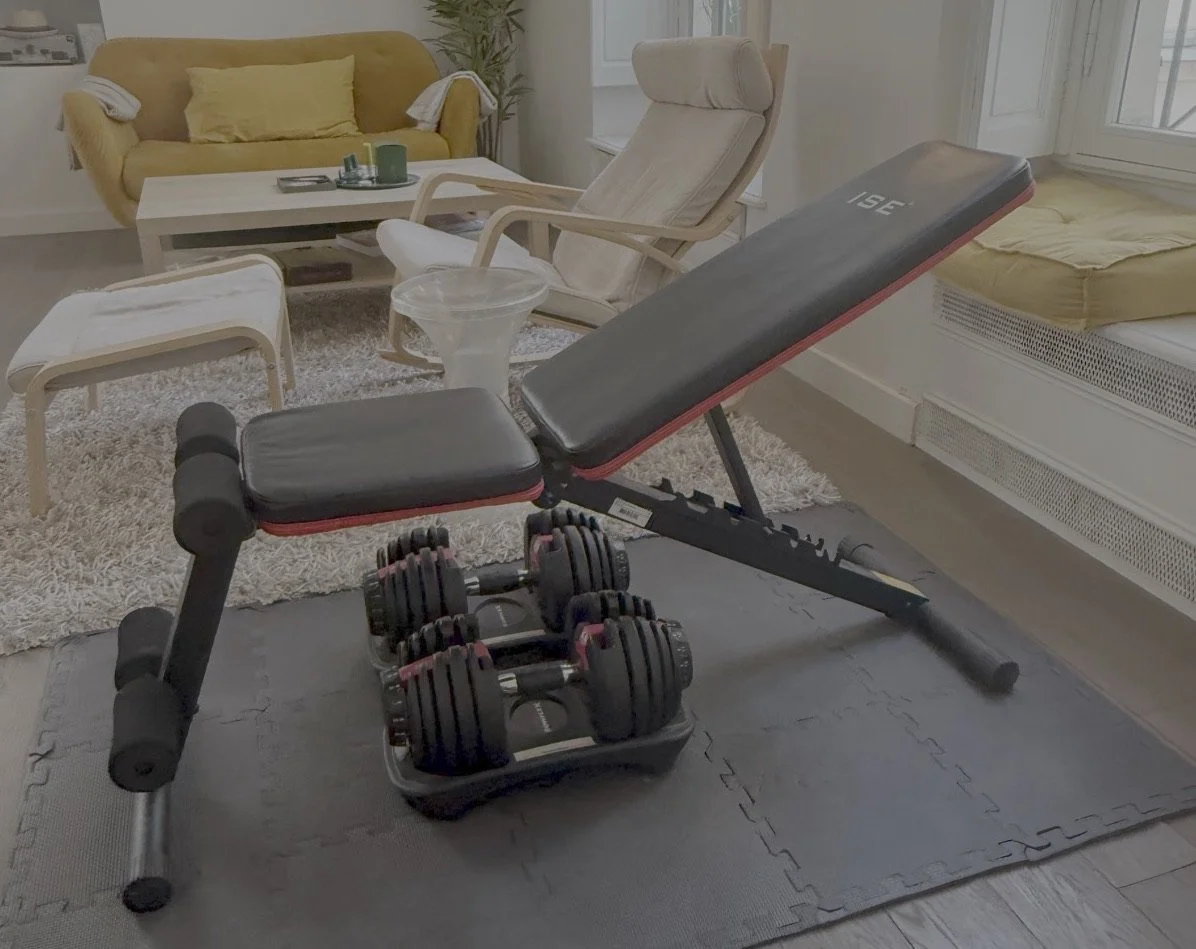
Build steadily with adjustable dumbbells, a bench and five simple movements.
2 days / weekLeave a rest day between2–3 reps in reserve
00–04 minutes
Warm up & get ready
March briskly, make small arm circles and gently squeeze your shoulder blades together. Rehearse presses and rows with very light weights.
Start with two rounds for the first two weeks. Build to three when comfortable. Choose a weight that leaves 2–3 good repetitions possible. Lower for about two seconds, lift smoothly and breathe out during the effort. Lock the bench and secure the dumbbell plates.
04–14 min: press → row on both sides → rest 60 seconds. Repeat 2–3 times.
14–25 min: curl → kickback on both sides → rest 45–60 seconds. Repeat 2–3 times.
25–28 min: gentle chin retractions.
28–30 min: walk, relax and record weights and repetitions.
Allow roughly 20–30 seconds to change position. The clock is a guide: take extra rest and complete fewer rounds if needed.
Videos need an internet connection. If a player is unavailable, use its source link. No video starts automatically.
04–14 minutes · pair A
Chest & back
Alternate these two moves. Rest 60 seconds after rows on both sides.
01 / Chest · triceps
Flat dumbbell chest press
8–12 repetitions
Enter any weight, including decimals. Saved on this device and browser.
Bench flat. Feet planted. Elbows 30–45° from your torso; wrists above elbows. Lower only as far as your shoulders comfortably allow. Use weights you can safely get into and out of position.
Mayo Clinic • combined demonstration includes chest press
Enter any weight, including decimals. Saved on this device and browser.
Brace one hand on the bench, feet staggered. Hinge forwards, keep your back steady and eyes towards the floor. Pull towards your hip without twisting or shrugging.
US Marine Corps • video shows the row; add bench support as described
Enter any weight, including decimals. Saved on this device and browser.
Support one hand on the bench and hinge forwards. Keep the working upper arm alongside your torso. Straighten the elbow, then return slowly. Keep the upper arm still; use much lighter weights than for rows.
Kickback demonstration • use the bench support described above
Sit tall, eyes level. Slide your head straight backwards to make a small double chin. Do not tip your head up or down. Release gently and rest between repetitions. This is gentle neck control, not weighted neck muscle-building.
Finish: walk around for two minutes, relax your arms and record the weight and repetitions for each move.
Make the next session count
When you reach the top of the repetition range on every set with good control and 2–3 repetitions in reserve, increase that exercise by the smallest available weight increment.
Comfort & safety
This starting routine assumes no current shoulder, elbow or neck injury and no medical restriction on lifting. If either applies, get the routine adapted before starting. Avoid holding your breath. Stop for sharp joint pain, tingling, dizziness or pain travelling into an arm. Chest pressure or unusual breathlessness warrants urgent medical attention.
Training frequency & sources
Train twice a week on non-consecutive days, for example Monday and Thursday. Continue walking and your usual lower-body activity. These exercises do not selectively remove belly fat.
Maintain and develop your legs, glutes and calves with dumbbells, a stable support and a mat.
2 rounds to startSteady, comfortable movementKeep breathing
00–05 minutes
Warm up & get ready
March for two minutes, then practise 6–8 comfortable bodyweight squats, 6–8 unloaded hip hinges and 8 slow calf raises while holding support. Secure the dumbbell plates.
Start with two rounds of each pair for the first two weeks, then build to three. Choose weights that leave 2–3 good repetitions possible. Lower smoothly for about two seconds and breathe out during the effort. Your strong legs still need time to learn unfamiliar movements.
25–30 min: Walk easily, then gently stretch calves and thighs if comfortable. Record each exercise’s weight and repetitions.
Allow 20–30 seconds to change position. The timings include rest and practice: finish early if two rounds are enough, or use the remaining time for an easy walk. Do not rush to fill the clock.
Videos need internet. Use the original guide if a player is unavailable. No video starts automatically.
Enter any weight, including decimals. Saved on this device and browser.
Start without weights to learn the movement; then hold one dumbbell in each hand at your sides. Feet roughly shoulder-width, toes slightly out. Bend hips and knees together, keeping heels down and knees following your toes. Use a comfortable depth; stand tall without snapping the knees. Easier: sit-to-stand from a stable chair. Do not stand on the bench.
Mayo Clinic • combined video includes dumbbell squat
Enter any weight, including decimals. Saved on this device and browser.
Stand with a dumbbell in each hand, knees softly bent. Push your hips backwards and keep the weights close to your legs. Keep your back steady and neck aligned. Stop when you feel a comfortable hamstring stretch, often around knee to mid-shin height; stand by driving through your feet. Do not reach for the floor. Easier: practise the hip hinge without weights.
Lie on a mat with knees bent, feet hip-width apart and arms at your sides. Gently tighten your abdomen, press through your feet and lift your hips until shoulders, hips and knees form a line. Keep ribs down; do not arch your lower back or push into your neck. Lower slowly. Start with bodyweight and keep both feet on the floor.
Enter any weight, including decimals. Saved on this device and browser.
Stand on level ground and lightly hold a wall or fixed counter. Rise onto the balls of both feet, pause briefly, then lower slowly. Keep your body tall and ankles steady; no bouncing. Start with bodyweight. If easy, hold one light dumbbell in the free hand and change hands halfway through. Use the same load on both sides. The video shows an unsupported version; use support as described.
Walk easily, then gently stretch calves and thighs if comfortable. Record each exercise’s weight and repetitions.
When every set reaches the top of its repetition range with 2–3 repetitions still possible, increase that exercise by the smallest weight increment. Keep bridges bodyweight initially; progress by control and repetitions. You can take 90 seconds of rest after the first pair when needed.
Comfort & safety
Stop for sharp pain, tingling, dizziness or feeling unwell. Chest pressure or unusual breathlessness warrants urgent medical attention. If you have back problems, osteoporosis, a hernia, recent surgery or a restriction on exercise, get this routine adapted before starting. Use a cushioned mat and get up slowly. Keep all exercises within a comfortable range.
Fit the routines into your week
These tabs are separate sessions, not a 90-minute workout. Begin by adding one lower-body and one core session to your existing upper-body sessions, spread across the week. Leave a rest day between hard sessions for the same muscles; bridges overlap between these two routines. Example: Monday upper, Tuesday lower, Thursday upper, Saturday core. Add frequency only when recovery feels good.
Build abdominal strength and trunk control with a mat, slow movements and steady breathing.
2 rounds to startSteady, comfortable movementKeep breathing
00–05 minutes
Warm up & get ready
Walk or march for two minutes. Lie comfortably on your back with knees bent and take five relaxed breaths; gently tighten your abdomen as you breathe out. Practise a few short heel slides and an easy hands-and-knees position.
Start with two rounds of each pair. Build to three if comfortable. Keep each movement controlled and finish before shaking, sagging or breath-holding. No external weights are needed for this starting core routine.
About your waist: these moves strengthen your core; they do not selectively burn belly fat. Combine them with regular walking, balanced meals and an overall sustainable energy deficit if fat loss is your goal. You can build strength while working on these habits.
05–15 min: Heel slide on both sides → bird dog on both sides → rest 45–60 seconds. Repeat 2–3 rounds.
15–25 min: Knee-supported side plank on both sides → bridge → rest 45–60 seconds. Repeat 2–3 rounds.
25–30 min: Walk easily for three minutes, relax your shoulders and record repetitions or hold times. Add a few relaxed breaths to finish.
Allow 20–30 seconds to change position. The timings include rest and practice: finish early if two rounds are enough, or use the remaining time for an easy walk. Do not rush to fill the clock.
Videos need internet. Use the original guide if a player is unavailable. No video starts automatically.
05–15 minutes · pair A
Control & coordination
Heel slide on both sides → bird dog on both sides → rest 45–60 seconds. Repeat 2–3 rounds.
01 / Abdominal control
Supine heel slide
6–8 slow repetitions each side
Bodyweight only · no dumbbell needed.
Lie on your back, knees bent and feet on the mat. Gently brace your abdomen while breathing normally. Slowly slide one heel away, only as far as you can keep your pelvis and back still. Bring it back and alternate sides. Keep your head resting down. Easier: shorten the slide. Do not add a resistance band.
Release Physical Therapy • heel slides; omit the optional band
Start on hands and knees with hands under shoulders and knees under hips. Gently brace, then reach one arm and the opposite leg away, keeping your hips level and eyes towards the mat. Reach long, not high; avoid arching or twisting. Return slowly and alternate. Easier: move only one arm or slide one foot back along the floor.
Knee-supported side plank on both sides → bridge → rest 45–60 seconds. Repeat 2–3 rounds.
03 / Side abdominal muscles
Side plank from knees
15–20 seconds each side
Bodyweight only · no dumbbell needed.
Lie on your side, knees bent and elbow directly below your shoulder. Lift your hips so shoulders, hips and knees form a line. Keep your neck relaxed and breathe throughout. Lower before your form falters, then change sides. Easier: use 5–10-second holds with rests. If shoulder or knee discomfort occurs, repeat heel slides instead.
Lie on your back with knees bent and feet hip-width apart. Gently brace your abdomen and lift your hips to align shoulders, hips and knees. Keep ribs down and breathe normally through the hold, then lower slowly. Keep both feet on the mat. This also appears in Lower body: skip extra bridge sets if you trained them yesterday and are still sore.
Walk easily for three minutes, relax your shoulders and record repetitions or hold times. Add a few relaxed breaths to finish.
Progress one thing at a time: lengthen a heel slide, add one repetition per side, or add five seconds to a hold. Build side planks towards 30 seconds with comfortable breathing before choosing a harder variation. End each set while you can still keep your trunk steady. Weights are unnecessary for these starting exercises.
Comfort & safety
Stop for sharp pain, tingling, dizziness or feeling unwell. Chest pressure or unusual breathlessness warrants urgent medical attention. If you have back problems, osteoporosis, a hernia, recent surgery or a restriction on exercise, get this routine adapted before starting. Use a cushioned mat and get up slowly. Keep all exercises within a comfortable range.
Fit the routines into your week
These tabs are separate sessions, not a 90-minute workout. Begin by adding one lower-body and one core session to your existing upper-body sessions, spread across the week. Leave a rest day between hard sessions for the same muscles; bridges overlap between these two routines. Example: Monday upper, Tuesday lower, Thursday upper, Saturday core. Add frequency only when recovery feels good.